

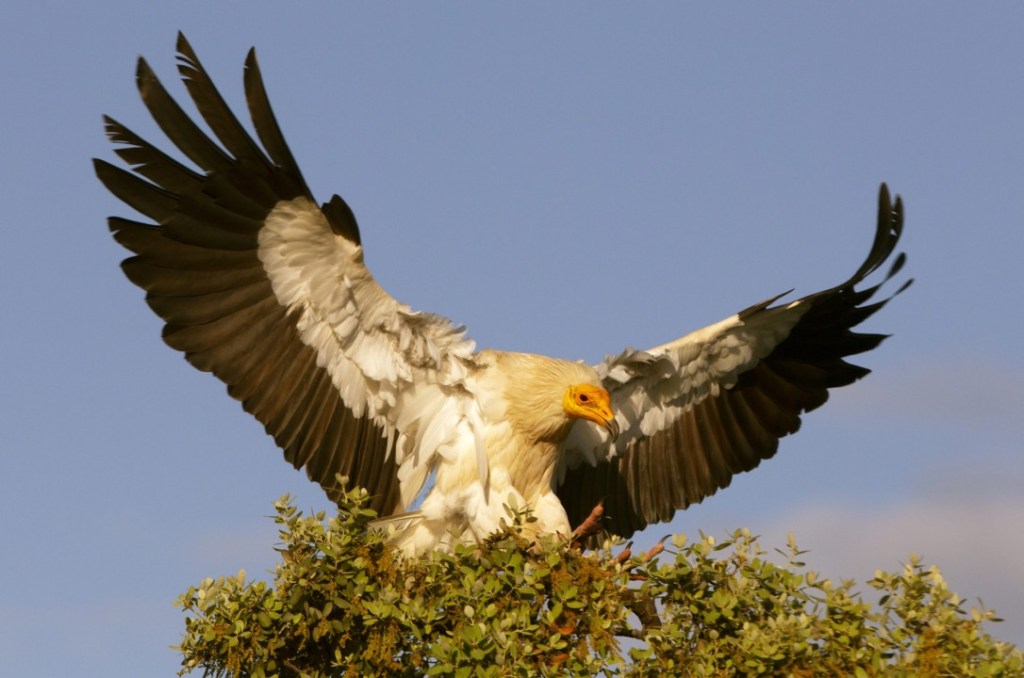
As the Egyptian vulture goes, so goes the world’s biodiversity. Hyperbole? No, not at all. Today, more than 41,000 species face possible extinction, including 41% of the world’s amphibians, 27% of mammals, and 13% of birds. The current extinction rate is estimated to be 1,000 times higher than natural background rates, and many experts fear it could increase to 10,000 times the normal background rate in the decades ahead. During the past 500 years, more than a thousand species are known to have gone extinct. More vanish every day. Without concerted, intense international efforts to address habitat loss, ecosystem degradation, poaching, and myriad other threats, the Egyptian vulture and tens of thousands of other species will disappear forever.
Vultures play an essential role in ecosystems around the globe. For eons, by cleaning up carcasses and consuming other organic waste in the environment, they have helped stop the spread of diseases in wild and domestic animals and reduced pathogenic risks to people. Despite this important ecosystem service, humans often persecute vultures based on misconceptions and negative stereotypes passed down for ages. Illegal shooting and intentional poisoning are major threats to all vulture species. Unintentional poisoning is also a major concern. Countless vultures have died after consuming livestock carrion laden with toxic veterinary medications and the bodies of dogs and wild predators poisoned by ranchers to protect their farm animals. Additionally, for the Egyptian vulture, the illegal wildlife trade (young chicks and eggs are stolen from breeding sites) and collisions with wind turbines and power lines pose grave threats to the species all along its lengthy migratory route between Africa and Europe.

Globally, vultures constitute the fastest declining group of birds. The Egyptian vulture is disappearing even more rapidly than most vulture species. Once widespread and common across a vast range that spans over 70 countries in Africa, Asia, and Europe, it now struggles for survival amid shrinking habitat, increasingly hostile man-made landscapes, and direct persecution. A 2021 assessment conducted by BirdLife International found that only between 12,000 and 36,000 mature adult Egyptian vultures remain. Since the 1980s, the population has declined by as much as 80% worldwide. The steepest decline has been in India, where the number of Egyptian vultures has plummeted by 99%. The situation in Africa is similarly grave. Populations on the continent have declined by 91% over the past three generations (approximately 40 years).

The Egyptian vulture has fared better in Europe than elsewhere, but still its population there has fallen by up to 50% in the last 50 years. Bright spots include stable and possibly increasing populations in France and Spain, where conservation efforts and policies are strongest. Elsewhere in Europe the situation is critical. The species has been extirpated in Bosnia and Herzegovina, Croatia, Montenegro, Romania, and Ukraine. In the Balkans, populations are declining by between 4% and 8% per year, resulting in an overall decline of between 81% and 97% in four decades. In Greece, which I recently visited in in hopes of seeing this iconic bird, the Egyptian vulture is now considered critically endangered. In 2000, researchers recorded 70 breeding pairs in Greece. By 2012 this number had fallen to 15 pairs, and by 2022, it is thought that only two breeding pairs remain in the majestic cliffs of the Meteora region.

Despite this bleak reality, there is still hope for the Egyptian vulture. In 2017, at COP12, the parties to The Convention on the Conservation of Migratory Species of Wild Animals adopted The Vulture Multi-species Action Plan, which provides a comprehensive, strategic conservation plan covering the geographic ranges of all 15 species of migratory African-Eurasian vultures, including the Egyptian vulture. The plan provides conservation management guidelines applicable to all 128 range states and lays out steps for concerted, collaborative, and coordinated actions to rapidly halt population declines and to improve the conservation status of each of these vulture species. International cooperation is imperative for Egyptian vultures in particular, because they must travel up to 5,000 kilometers when migrating between their breeding sites in Europe and their wintering grounds south of the Sahara desert.
Non-governmental organizations, such as The Vulture Conservation Foundation (VCF) are leading efforts to conserve vulture species. VCF has spearheaded public education and policy change campaigns across Europe to ban the veterinary drug Diclofenac, which is extremely lethal to vultures, and to combat the illegal, intentional poisoning of vultures and other wildlife. VCF also runs Egyptian vulture captive breeding, restocking and reintroduction programs in Bulgaria and Italy, as well as similar programs in other European countries for other species of vultures.
With so many species already on the brink of extinction, actions like those taken by VCF are essential. Yet, to reverse the Anthropocene extinction taking place across our planet, humankind must embrace a new relationship with the non-human world. Stopping the mass annihilation of species and reversing our planet’s overall ecological decline requires that humanity grow out of our anthropocentric worldview, signaled by rampant over consumption and spurred by notions that perpetual growth on a finite world is possible. We must embrace an eco-centric worldview that normalizes and promotes restorative behaviors and harnesses the compassion and ingenuity of humankind to be stewards rather than exploiters of nature. Failure to do so will undoubtedly result in the continued mass extinction of non-human life on Earth, and it may well lead to our own demise.
 Aegis Conservation Ecology & Regenerative Development LLC
Comments